July 04, 2026
Value Creation in Private Equity: Building Enterprise Value in a Dynamic Business Environment

Value Creation in Private Equity: Building Enterprise Value in a Dynamic Business Environment
Fernando Kevin Vince
PhD, DBA, MBus (Prof Acc), MSc (Strategic Marketing), FCIM, FIPA (Australia), CFC (USA), CPM (UK)
Abbreviations
AI – Artificial Intelligence
EBITDA – Earnings Before Interest, Taxes, Depreciation, and Amortisation
ESG – Environmental, Social, and Governance
Executive Summary
Private equity has evolved from a financial engineering model into a value creation model. Rising interest rates, increasingly selective capital markets, ESG expectations, technological disruption and longer holding periods have increased the importance of operational improvement. This paper synthesises existing literature into a practical framework for understanding how private equity firms create value. It argues that sustainable value creation depends on the integration of strategy, operations, finance, innovation and governance. The strongest firms identify value drivers early, embed value creation into strategy execution and deploy initiatives that improve EBITDA, cash flow, debt capacity and long-term competitive position.
Introduction
Organisations operate in an environment characterised by uncertainty, rapid technological change and increasing stakeholder expectations. Six major forces influence business performance:
- Macroeconomic conditions
- Capital market and exit conditions
- Technology disruption
- AI adoption,
- Regulatory and ESG requirements
- Industry structure
Higher interest rates and more disciplined credit markets have reduced the ability of firms to rely on leverage alone. Consequently, investors increasingly seek businesses capable of generating sustainable growth, resilient cash flows and strong competitive positions. Technology and AI are reshaping industries while Industry 5.0 extends the focus from productivity to resilience, sustainability and humancentric value creation.
The private equity industry has evolved to become more sophisticated and demanding. Investors increasingly favour firms that possess repeatable value creation systems. Holding periods have lengthened and investors expect stronger EBITDA growth rather than reliance on multiple expansion. As a market, Asia remains attractive because private equity penetration is lower than in developed markets, creating opportunities for firms that can systematically improve portfolio company performance. In this environment, value creation capabilities become a key source of differentiation.
Strategically Building Enterprise Value
Strategy must be the foundation of value creation. Strategy determines where a company will compete and how it will create value. Drawing on Porter (1996) and Rumelt (2017), effective strategy combines a differentiated position with a focused response to critical challenges. Within private equity, value creation should be embedded in the strategy cycle. Business vision, shareholder expectations, market realities and operational capabilities interact to generate value creation opportunities that translate into initiatives. These initiatives must be sequenced, measured and adapted depending on the individual organisational situation and how market conditions evolve. Value creation therefore becomes a continuous process rather than a one-time transformation project.
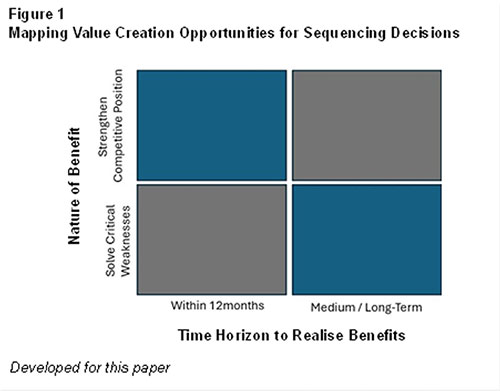
Value creation begins with understanding value drivers.
Financial value drivers include:
- Revenue growth
- Operating margins
- Return on invested capital
- Working capital efficiency
- Cash generation
Operating value drivers include:
- Customer loyalty
- Innovation
- Employee productivity
- Product quality
- Market position
A key insight from the literature is that value driver identification should precede value creation opportunity mapping. Companies that understand their value drivers are better positioned to allocate resources and prioritise initiatives that increase enterprise value.
In the paragraphs that follow we will explore broad categories of value drivers.
Revenue Value Creation – the focus here is on profitable growth. Organisations should understand customer profitability, product profitability and sources of differentiation. Growth opportunities may come from
- Increased share of wallet
- Market expansion
- Product innovation
- Acquisitions
- Pricing improvements
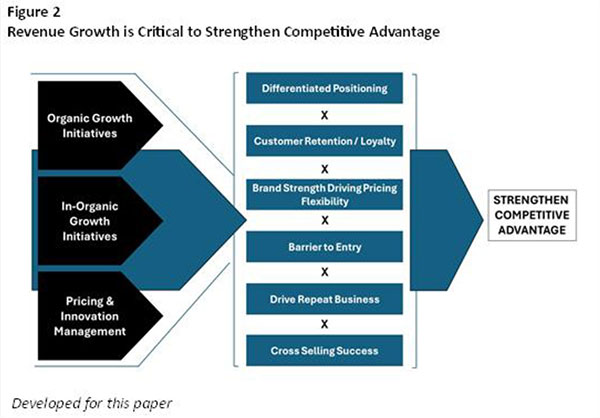
Figure 2 outlines the importance of growth having a direct impact on key variables that contribute to competitive advantage. The literature highlights the importance of applying 80/20 analysis to customers and products. Not all customers create equal value. Firms should identify high-value customers and invest resources where economic returns are greatest. Sustainable revenue growth requires a compelling value proposition supported by strong customer relationships, brand positioning and competitive differentiation.
Operational value creation – the focus here is to improve the effectiveness and efficiency of the business. Opportunities exist across:
- Procurement
- Operations
- Logistics
- Sales
- Customer service
- Support functions
Lean management, automation, process redesign and digital transformation can improve productivity and margins. Porter’s value chain remains relevant but may be updated for the digital business environment. Industry 4.0 technologies enable organisations to connect, automate and optimise operations, while Industry 5.0 extends these capabilities to improve resilience, adaptability and customer-centricity. Operational excellence often represents the largest source of value creation because it influences both profitability and scalability.
Financial value creation – the focus here is on cash generation, capital allocation and capital structure optimisation.
Private equity firms seek to improve enterprise value through working capital improvements, debt reduction, disciplined capital expenditure and stronger cash conversion.
Resource allocation decisions should be based on expected cash flows and returns relative to the cost of capital. Improvements in working capital release cash that can be used to fund growth or reduce leverage. Stronger free cash flow supports debt paydown and ultimately increases equity value.
Financial discipline therefore acts as a bridge between operational improvement and investor returns.
Innovation – as a system and investment initiative, this protects future value differences from operational improvements that aim to enhance current performance. Organisations must continually adapt to changing customer expectations, technologies and competitive threats. Innovation can take the form of products, services, business models, partnerships or operating practices.
Companies that innovate successfully create new revenue streams and strengthen their competitive position. Increasingly, AI and digital technologies support innovation by improving decision-making, accelerating development cycles and enabling personalisation at scale. Digital technologies have allowed companies to transform their entire business scope and go-to-market models.
Multi-Dimensional Value Creation
Value creation needs to extend beyond financial performance. The literature identifies several dimensions including:
- Stakeholder relationships
- Efficiency and cost management
- Innovation and differentiation
- ESG performance
- Measurement systems
- Financial performance.
These dimensions reinforce one another:
- Strong stakeholder relationships improve loyalty and trust.
- ESG performance enhances resilience and access to capital.
- Effective measurement systems create accountability and facilitate continuous improvement.
Together, these create a stronger and more sustainable enterprise.
Although value creation initiatives are diverse, their outcomes typically appear in three ways:
- EBITDA growth reflects stronger commercial and operational performance.
- Debt reduction reflects improved cash generation and balance sheet strength.
- Multiple expansion reflects enhanced market attractiveness and investor confidence.
These three drivers combine to increase enterprise value and ultimately determine investor returns.
Conclusion
The contemporary private equity industry rewards firms capable of creating genuine value rather than relying on financial leverage alone. The most successful firms integrate strategy, operations, finance, innovation and governance into a coherent value creation system. They understand value drivers, prioritise initiatives effectively and maintain disciplined execution. As competition intensifies and capital markets become more selective, operational value creation, innovation and strategic adaptability will become even more important sources of sustainable enterprise value and superior investment performance.
Bibliography
Chandra, P, (2014) Strategic Financial Management, Managing for Value Creation, McGrawHill Education. India.
De Vusser, C, Grupi, M, Brusselmans, G, & Toner, M, (2025) Value Creation: What It Is and Why It Matters? October, Bain & Company
EY (2026) Southeast Asia Private Equity Deal Value Declined in Year 2025, But Market Regains Momentum, February, https://www.ey.com/en_sg/newsroom/2026/02/southeast-asia-private-equity-deal-value-declined-in-2025-but-market-regains-momentum
Frykman, D, & Tolleryd, J, (2003) Corporate Valuation. An Easy Guide to Measuring Value. Prentice Hall, Pearson Education, UK.
MacArthur, H, Burack, R, Rose, G, Schmitz, A, Yang, K, & Lamy, S, (2026). Private Equity Outlook 2026: Gaining Traction | Bain & Company. https://www.bain.com/insights/outlook-gaining-traction-global-private-equity-report-2026/
Moonfare (2025) A Quiet Power Shift is Underway in Asia-Pacific Private Equity, November. https://www.moonfare.com/sg/blog/asia-pacific-private-equity-2026
Porter, ME, (1996) What is Strategy? November – December, Harvard Business Review, Reprint, USA.
Rumelt, R, (2017) Good Strategy/Bad Strategy. The Difference and Why It Matters, Profile Books, Ltd. USA.
Rut, J, & Ostafil, M, (2021) The Value Chain in the Digital age, Economics and Organisation of Logistics, 6(4), P101-112. Opole University of Technology.
Strategex (2022) The Executive’s Guide to Fast Value Creation. An 80/20 Webinar for Operating Partners & PE-Backed Executives. SS26NA 15 MIX 16x9 EN https://www.youtube.com/watch?v=PFwtBp5ySXs