August 14, 2026
Making Value Creation a Long-Term Strategic Discipline
Fernando Kevin Vince
PhD, DBA, DM, MBA, MSc, MBus (Prof. Accounting), BA, FIPA (Australia), CPM (UK), FCIM (UK), CFC (USA)
Introduction
Business environments today are characterised by technological change, geopolitical issues, supply chain uncertainty, rising customer expectations, and long-term investors. Research indicates that to sustain value creation an organisation needs to make choices around its market and portfolio, deciding which businesses to keep and which to get out of and how to manage their exposures. There is a need to build distinctive assets that differentiate them to customers in meaningful ways. Strategy efforts need to define where market leadership positions can be developed or defended to provide superior returns. There has to be the ability to build repeatable business models and renew them. This includes investment in mergers and acquisitions. On the financial strategy front, decisions have to be made about the right trade-off between reinvestment in the business and the requirements of equity and debtholders (Vusser, Crupi, Brusselmans & Toner 2025).
Value is a ubiquitous term, yet if you speak with a hundred executives you will get a hundred different definitions. Value creation initiatives aim to impact revenue growth and market share protection, competitive repositioning and efficiency (Trotta 2003). Value creation needs to become a management system that is a repeatable and organisation-wide discipline that shapes decisions every day rather than only during annual budget and strategy planning. As a deliberate process that generates sustainable economic value to key stakeholders there are opportunities to learn from enduring management disciplines such as LEAN, ESG and ISO9000. This paper dives into these issues and provides a framework to make value creation a long-term strategic discipline.
Long-Term Measures of Enterprise Value
Anybody can get lucky, at least for a while. They can launch a product that takes off with consumers, catch a tailwind from secular growth trends, or form a company during a historically anomalous period of low interest rates and stable economic expansion. Sustained value creation is hard. Research by Bain (Vusser et al. 2025) indicates that less than half of all companies in our database generated an economic profit in 2024. Slightly more than a quarter generate revenue growth higher than inflation. Less than 20% of all companies manage to deliver both a positive economic profit and real top-line growth in a single year (Vusser, Crupi, Brusselmans & Toner 2025).
In a commercial enterprise the objective is long-term enterprise value creation. To achieve this we need to understand the drivers. The most widely used metrics to evaluate enterprise value creation by private equity firms and long-term investors revolve around (Koller, Goedhart & Wessels (2025) and Thorndike (2012):
- When profitable growth answers the essential question whether the enterprise is growing earnings sustainably, typical metrics include revenue growth percentages, EBITDA (Earnings Before Interest, Taxes, Depreciation, and Amortization) growth percentages, gross margin percentages and EBITDA margin percentages.
- Cash flow generation is the next metric. It answers the question: How efficiently does the enterprise convert profits into cash? Typical metrics include operating cash flow, Free Cash Flow (FCF), cash conversion such as percentage of EBITDA to free cash flow and operating cash flow margins. Strong cash conversion is important because it allows a company to reduce debt, fund growth, and return capital to shareholders.
- Return on Invested Capital (ROIC) answers the question: How effectively is the enterprise deploying its capital. Typical metrics include ROIC, Return on Capital Employed (ROCE), Economic Value Added and Asset (EVA) turnover. A company creates value only when its returns are above its cost of capital.
EV Creation Equation:
Grow earnings → Convert earnings into cash → Reinvest capital at high returns
This creates a virtuous cycle where higher earnings increase cash generation. Strong cash generation funds future investments. High-return investments generate even more earnings and cash. The cycle repeats, compounding enterprise value over time. These three metrics provide a balanced scorecard for long-term value creation: grow, generate, reinvest. Companies that consistently improve all three are the ones most likely to achieve sustained increases in enterprise value.
Strategic Value Creation
Value creation is a fundamental approach that shapes direction and defines the business purpose. It is the synergy of innovative thinking, unwavering commitment, and an acute understanding of the diverse stakeholders in today’s interconnected world. Business exists to create value, thus value creation should be the compass that guides strategic and operational decisions. Value creation as a strategic and long-term discipline arguably becomes more important as organisations get larger. It helps the organisation evaluate alternative value creation options in terms of:
- Timely capture of economic and industry trends (e.g. the semi-conductor boom, electrification, etc.)
- Investments and transformation that will strengthen the competitive position through differentiation or position in the industry value chain (e.g. Apple has 20% market share of smart phones but capture 80% of its profits. Bolt-on acquisitions building integrated capabilities so that they could move up the customer value chain, etc.)
- Operations improvements in terms of efficiency, effectiveness and asset utilisation (i.e. OEE, DPPM, COPQ, supplier consolidations, etc.)
- Improving metrics that drive higher market valuation (e.g. Sustained profitable growth, margin % and free cash flow, etc.)
A useful reference point to explore how to make value creation a long-term strategic discipline is to draw lessons from organisation-wide systems such as ISO 9000, ESG, and LEAN. These systems go beyond being a set of tools but are positioned as management philosophies that create sustainable competitive advantage. It is what we aim to achieve from strategic value creation initiatives over the long-term. These systems share several enduring principles that could form the foundation of a long-term value creation strategy. Table 1 presents a summary of these principles (ISO 2025, IBM 2026, Magnani, Balle & Beauvallet 2024).
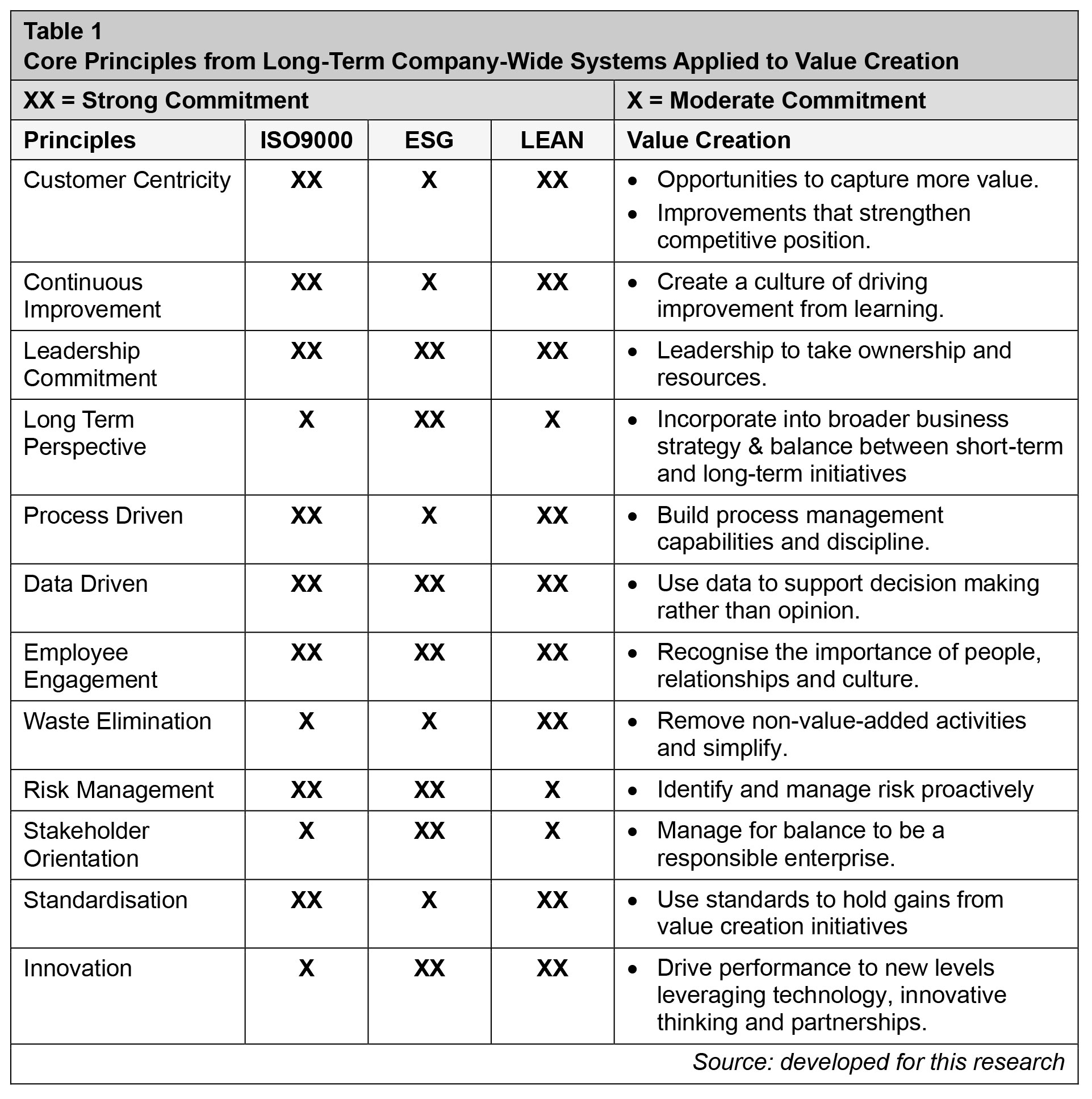
Distilling the insights from table 1, we can arrive at ten core value creation principles:
1. Customer value – Every value creation initiative should either improve customer value and/or enable the company to capture more value to improve the market power versus the competition (i.e. Improved Competitiveness).
2. People, Processes, then Technology – recognise that at the core are competent, capable and empowered people to design and deploy value creation initiatives through strong process discipline, supported by technology.
3. Continuous Improvement – Small improvements compound into significant enterprise value and build required commitment and culture.
4. Long-term business strength – projects and decisions taken should strengthen the business for the long-term versus borrowing from a future period to look good in the short-term.
5. Operations excellence through process discipline – establishing repeatable processes that create scalable businesses.
6. Data-driven decision making – decisions should be grounded in facts and measurable outcomes. Use data-driven performance insights to guide resource and capital allocation decisions.
7. Eliminate waste and constraints – Simplify processes and remove non-value-added complexity to allow focus to achieve more with less.
8. Sustained and responsible growth – financial success through revenue portfolio risk management alongside responsible environmental, social and governance practices.
9. Manage risk proactively – part of long-term value creation requires anticipating and mitigating operational, financial and strategic risks. Building businesses that could perform across economic cycles.
10. Future ready investments – Continuously invest in people, technology and innovation to sustain competitive advantage.
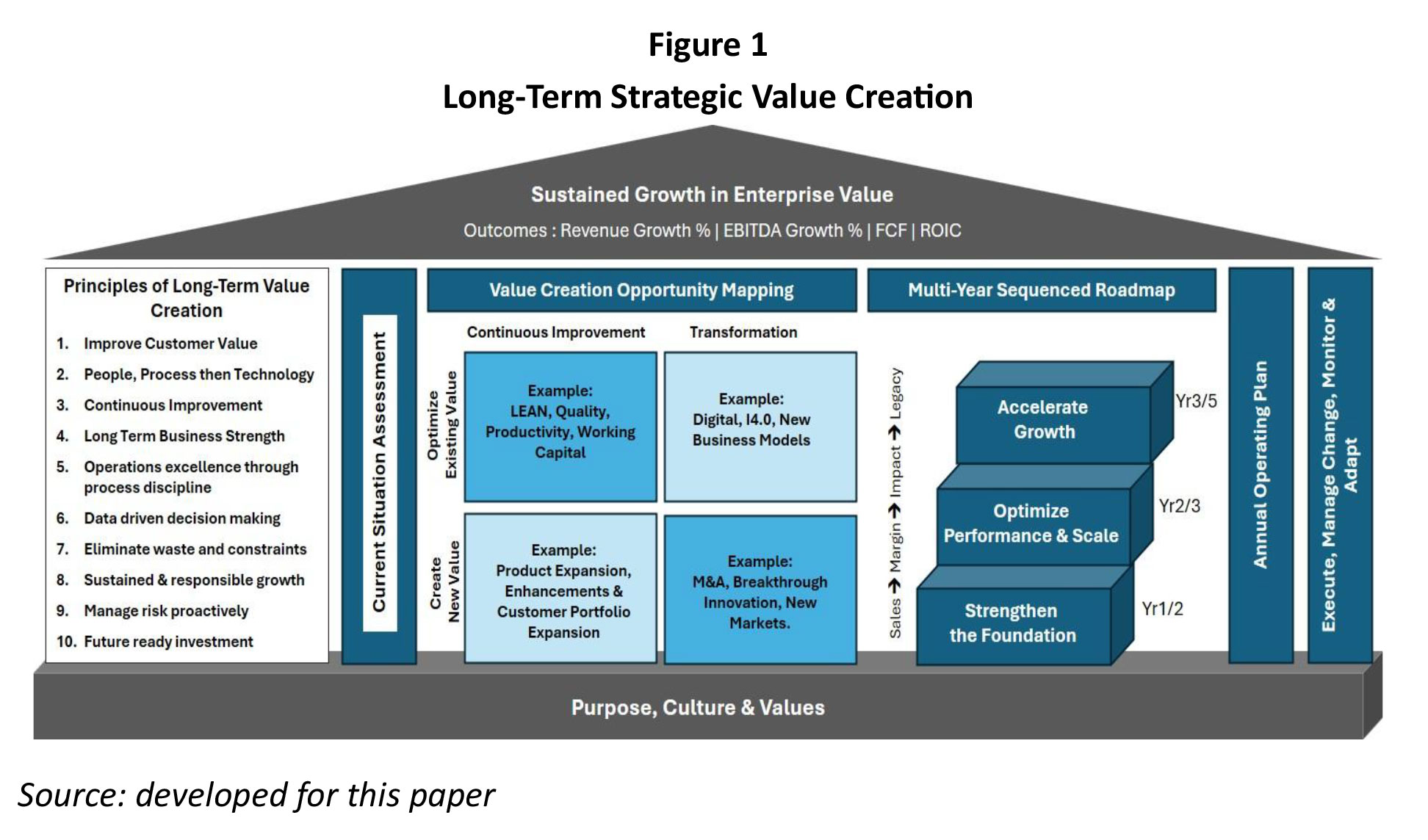
Sequencing of value creation initiatives is critical. The concept of business hierarchy of needs highlight that a healthy company must first attend to the base needs of sales, profit and order before the leadership can focus on more advanced pursuits such as impact and legacy (Michalowicz, 2020).
Operationalising Strategic Value Creation
The principles defined above have little value if not operationalised as part of the organisation’s management operating system.
- ISO 9000 provides the discipline.,
- Lean provides the improvement engine.
- ESG provides the lens for long-term stewardship.
Together, these guide leaders in deciding where to invest, what capabilities to build, and how to measure progress over a multi-year horizon. A simple way to operationalise the framework is through five sequential steps:
1. Assess the current state – the firm can develop a simple checklist to arrive at a baseline assessment of where the company is against the ten value creation principles. A cross functional team can be formed such as thinking through what would be done for a situation analysis as part of strategy. The outcome could be a value creation “Heat Map” highlighting strengths, weaknesses and the initiatives with the greatest potential impact.
2. Define the future state – this could be expressed in terms of objectives and key results in future success would look like. It could be in terms of revenue size, EBITDA percentages, year over year growth levels, market share, revenue portfolio mix, market positioning in the mind of customers, etc. This creates a common destination and future state for the organisation.
3. Build a multi-year value creation roadmap – rather than launching dozens of unrelated projects, group initiatives under a few broad theme critical to the achievement of the future state. Map each of the initiatives against the value creation principles identified and consider the right sequencing. For example, group the initiatives in terms of horizons. This could be: Yr 1 Building the foundations Yr2 Optimising Performance Yr3 Accelerating Growth. The challenge here is to filter out initiatives that do not have the prospect of creating enterprise value.
4. Develop adequately detailed annual operating plans that address not just the what but also the how. Attention should be paid to alignment, structures, resources and managing for coherence. Tools such as the balanced scorecard, strategy maps and goal deployment are useful at this stage. Each function, be it operations, finance, HR, commercial, supply chain and engineering own initiatives must be aligned to the common framework.
5. Measure progress through an integrated set of value driver metrics that cut across the organisation and align functions toward strategic outcomes linked to value creation (i.e. Understand the cause-&-effect relationship of performance metrics across the organisation functions and levels). It is not only about measuring financial results but also capability-building lead measures and outcomes.
A useful way to explain the framework is as a cascade: Align the organisation around long-term principles; assess current situation against these principles; map and classify value creation opportunities; select a cohesive mix of short and long-term value creation initiatives over three time horizons; develop detailed actions plans for those that will be deployed in the next 12 months; address change and performance management actions to support effective execution with flexibility to adapt in response to emergent issues.
Embracing a framework, like Figure 1, emphasises that enterprise value is the result of consistently building stronger capabilities over time, not simply pursuing short-term financial gains. The framework also helps leaders a practical way to answer four fundamental questions every year:
1. What capabilities must we strengthen? Guided by the principles.
2. What initiatives will build those capabilities? The multi-year roadmap.
3.How will we know we are making progress? KPIs and maturity index measures.
4. How does this create enterprise value? Financial and Strategic Outcomes that improve competitive positioning.
In this way, the framework acts as both a strategic compass and an execution system. It aligns investment decisions, annual business planning, operational improvement, leadership development, and governance around a single objective: building a higher-quality, more resilient, and more valuable business over the long-term.
Conclusion
Sustainable enterprise value creation does not occur by chance; it is the result of deliberate choices, disciplined execution, and a long-term commitment to strengthening the business. As organisations navigate increasingly complex market conditions, the ability to consistently grow earnings, convert profits into cash, and reinvest capital at attractive returns becomes the foundation of enduring success. These outcomes, however, cannot be achieved through isolated projects or annual planning exercises alone.
Drawing lessons from established management systems such as ISO 9000, Lean, and ESG, this paper argues that value creation should be embedded as an organisation-wide management discipline. By embracing principles such as customer centricity, continuous improvement, data-driven decision making, operational excellence, proactive risk management, and future-focused investment, organisations can build the capabilities required for sustained competitive advantage.
Ultimately, long-term value creation is about creating a stronger, more resilient enterprise that can perform across economic cycles while meeting the needs of customers, employees, investors, and society. Organisations that systematically assess their current position, define a compelling future state, execute a coherent multi-year roadmap, and measure progress through meaningful value drivers will be better positioned to compound enterprise value over time. In this way, value creation becomes not simply a strategic objective, but a continuous discipline that shapes decisions, investments, and performance for years to come.
References
Collins, J (2001) Good to Great, Harper Business.
Dieffenbacher, SF, (2024) Value Creation Definition, Model, and Examples in Business, Value Creation Definition, Model and Examples in Business, Digital Leadership.
IBM (2026) What are ESG Frameworks? | IBM
ISO (205) ISO 9001:2015Quality Management Systems Requirements. https://www.iso.org/standard/62085.html
Koller, T, Goedhart, M, & Wessels, D, (2025). Valuation: Measuring and Managing the Value of Companies, 8th Edition, McKinsey & Company.
Magnani, F, Balle, M, & Beauvallet, G, (2024. LEAN is a Strategy, A Research Agenda for Lean Management (pp.15-34). Publisher: Edward Elgar Publishing.
Michalowicz, M, (2020). Fix This Next. Make the Vital Change That Will Level Up Your Business, Portfolio / Penguin, USA.
Thorndike, WN, (2012). The Outsiders: Eight Unconventional CEOs and their Radically Rational Blueprint for Success, Harvard Business Review Press
Trotta, RJ, (2003) Translating Strategy into Shareholder Value. A Company-Wide Approach to Value Creation, Amacom, USA.
Vusser, CD,Crupi, M, Brusselmans, G, & Toner, M, (2025). Value Creation: What It Is and Why It Matters. Creating Value is Every CEO's No. 1 Priority. Here's What It Takes. Bain & Company.