December 12, 2025
Is Your Finance Function Holding Back Growth? Unleashing its Strategic Potential
Fernando Kevin Vince
PhD, DBA, MBA, MBus (Prof Acc), MSc (Finance) FIPA (Australia), FCIM (UK), CPM (SBP UK)
Growth Paradox, is Finance Part of the Problem or the Solution?
It is common that leaders rise through the ranks, yet never get formal finance training, nor are able to take time out to gain depth in this area. Decisions around growth plans, annual budgets and day-to-day operations made under ideal conditions should drive value creation and manage risk, be it operational, commercial or financial. If this is the reality, then finance needs to play a strategic role to unleash growth potential. It is not simply about understanding the business or contributing ideas from other markets on how to sell or market, or over-emphasising controls and risk avoidance. Instead, there is an urgent need for finance leaders to pause and query:
- What strategic decisions does the organisation need to drive sustained profitable growth?
- What internal and external sources of financial data can be mined for objective insights to help general managers and commercial leaders make informed decisions? Information may come from SEC filings, competitor financial reports, analyst reports, etc.).
- How should financial strategies be designed so that they allocate limited resources to drive value creation through growth, while managing risk at agreed levels?
The business environment is increasingly volatile and complex. Today’s core business is unlikely to be an engine of growth for tomorrow (McGrath & MacMillan, 2009). Only about one in nine companies has sustained more than a minimum level of profitable growth during the past decade (Zook & Allen, 2016). If this is the reality, the ability of finance to support transformation and future investments for growth becomes critical, versus its traditional role of reporting, control and compliance. Depending on the stage an organisation, business unit or product line, is in its life cycle, there has to be a balance between profitability management versus growth revitalisation.
Different management systems are required for different stages of business maturity (McGrath & MacMillan 2009). For example, if an organisation aims to grow through mergers and acquisitions, but the finance team has limited capabilities in these areas, the speed of executing this will be significantly hindered, not to mention the risk of missed opportunities or overpaying for a deal.
Finance inhibits growth when it creates obstacles or promotes a system of blame, bias and self-protection. Transformation as part of a solution implies figuring out what part of the puzzle the finance function fits in. It involves:
- Defining the role of finance, depending on the stage of the business, and choosing to contribute positively.
- Focusing on what can be done to help, versus picking on what is wrong.
- Collaborating with other functions involved in building and executing growth plans.
- Prioritising actions and resource allocations that drive lasting value creation, versus quick fixes and short-term results.
- Bringing a mindset on: How to help? Where to start to help fix issues? Being open to possibilities.
The rest of this paper draws on prior research around growth and the reasons companies stop growing, and explores how finance as a strategic partner can unleash the growth potential of the firm and avoid stalled growth. General managers and commercial leaders need to make decisions daily that aim to protect their current revenue base while continuously seeking new sources of profitable growth. The value-add role of finance is discussed.
Growth and the Strategic Partner Role of Finance
Growth matters not just for a company’s performance but also for survival. Sustained value growth is the key to long-term value creation. Finance brings the greatest value when it collaborates effectively with other functions. Fostering cross-functional collaboration especially between finance, commercial and customer facing functions is critical. These collaborations can help improve cash flow, lower costs, forecast financial and risk positions, boost the productivity of teams, enable experimentation with new business models, and find innovative solutions to create value (Bos 2024).
Scaling is part of growth and there are challenges relating to it such as:
- Defining the right rate of growth.
- Funding investments to ensure that quality levels are maintained.
- Supporting business model changes required as revenue grows.
- Establishing a system to help commercial teams know when to say "no" to certain projects, or knowing which customers to spend more time and effort with
- Building a complete sales strategy that includes the financial implications
- Auditing for alignment of spend
- Providing timely data insights about customers, pricing, margins, products, markets and channels, avoiding data fragmentation resulting from too many disconnected tools and making better use of automation and delegation.
These are the real business issues relating to the pursuit of growth and scale. Organisations add complexity, pile on processes and systems and dilute the sense of insurgency. Professional functional leaders are employed who focus on functional excellence, which often leads to creating disparate functional agendas and neglecting the customer. The organisation loses focus and forgets that their agenda should be defined by the business strategy (Zook & Allen 2016).
The digital era has created some interesting developments in the market. There are three defining characteristics between companies that have taken off very fast versus those that have struggled to gain momentum. Those that took off quickly, first required few physical and business infrastructure investments and few decision makers to make things happen. Second, the new offerings had a relative advantage over competitors and required little behavioural change. Third there was a low perceived risk in relation to speed to acquire and use, with low switching costs and low costs of failure (Wunker 2011). These three characteristics contribute to a superior value proposition which is at the core of competitiveness. Innovations need to deliver on dimensions of performance that enough customers care about. This radically changes the cost-benefit ratio and the criteria customers use to define value (McGrath & MacMillan 2009).
Funding growth requires:
- Investment in core enhancements to reduce costs or to grow the core.
- Future focus investments to establish a firm in a new growth area, typically involving new capabilities and new markets.
Creating options for the future often start with investments to learn. These are small investments, relative to the upside potential and the opportunity to stage the investments over time with the option to exit. Disciplined efforts are needed to manage the rate of investment so that cost build up is aligned with revenue streams. These are areas where strategic finance with a strategic growth mindset can provide significant value-add.
Industry leading growth requires firms to fire on multiple growth engines, which can be split into three cylinders – mergers and acquisition, portfolio momentum (strategic choices relating to the allocation of resources to high growth market, products and opportunities, and share gain strategies, which may be the most challenging unless the organisation has a clear plan to win across its segments. Strong growth requires distinctive performance on at least one growth cylinder. Exceptional growth comes from distinctive performance with in two or three cylinders (Viguerie, Smit & Baghai 2007). Depending on their focus, finance teams need the capabilities to support the entire process from planning and decision making to adaptive execution.
Figure 1 presents a framework, grouping the financial partnership role into three primary areas:
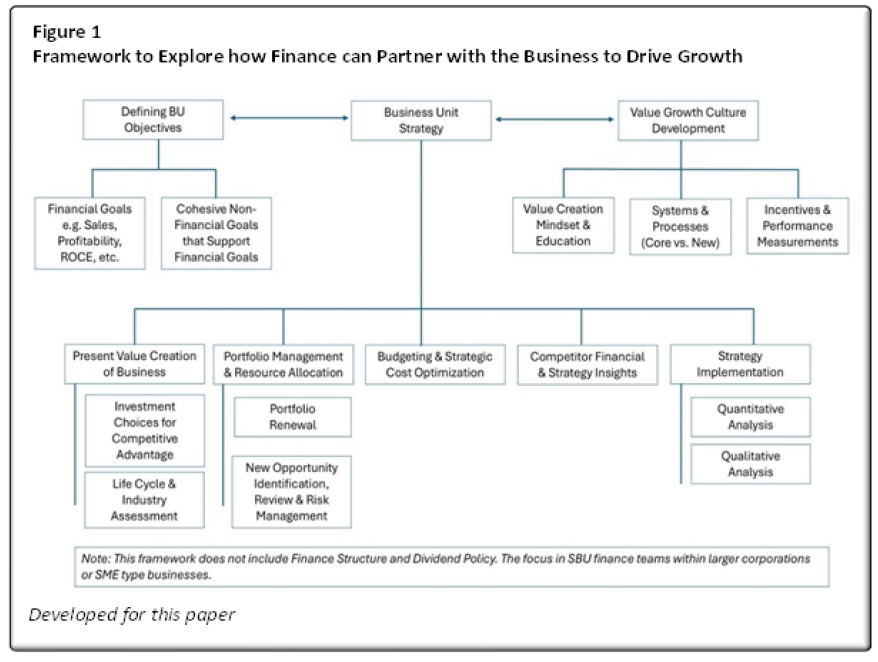
Defining Business Unit Objectives – defining the right financial metrics for goal setting and ensuring the alignment of financial and non-financial goals as they cascade across functions and levels. Financial goals lag behind performance measures. Lower-level goals need tight alignment to ensure financial goals are achieved.
Supporting the Design, Deployment and Evaluation of Business Unit Strategy for the current business:
- Evaluating and strengthening the revenue portfolio, while protecting the core.
- Protecting the core,
- Identifying and developing new growth opportunities. At the same time, risk must be managed to keep it at acceptable levels.
- Working on budgets and leading cost optimisation strategies to free up resources to fund growth initiatives.
- Deep diving competitor financials to provide strategic insights into their growth strategy design and resource deployment choices.
Building Across the Organisation
- Extending beyond the finance function should help teams embrace a value creation mindset
- Putting in place systems and processes that support the core and allow for experimenting with new growth options.
- Linking incentives to performance and use them as a tool to align efforts, drive accountability and reward results.
Dimensions outlined in Figure 1 where finance is strategically partnering with the business to drive growth align with research around growth leading organisations:
Breakthrough growth is not only about launching bold new initiatives. Many good growth programs start with incremental growth which requires investments in learning where big new opportunities lie. In dynamic environments bold but uncertain outcomes are not predictable. Investments are made over time to reduce the assumptions to knowledge ratio (McGrath & MacMillan 2009).
Fit for growth companies do three things consistently:
- Focus on a few differentiating capabilities that provide them the right to win in the market;
- Align their cost structures to funnel required resources to these capabilities
- Organisation model and processes to enable and reinforce these capabilities to deliver profitable growth (Couto, Plansky & Caglar 2017).
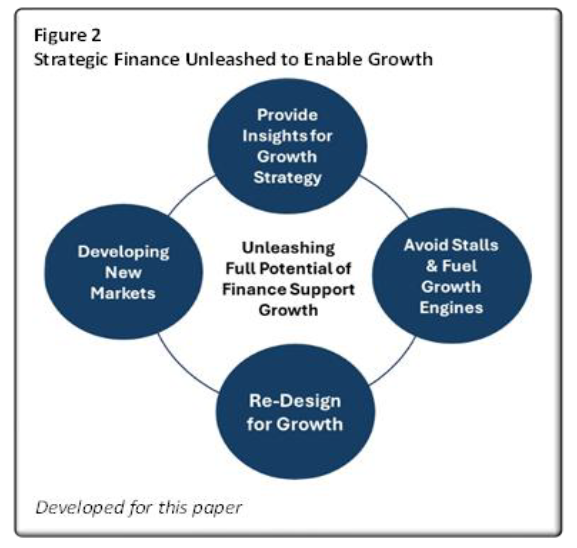
Unleashing the Strategic Potential of Finance
Progressing from the discussion on growth, the strategic potential for finance may be summed up in four main areas presented in Figure 2.
Finance Providing Insight for Growth
Various sources of internal and external data can be mined to provide useful insights into company performance trends, industry and competitor actions.
Internal sources are useful for growth planning. Management needs to be at a granular level beyond traditional financial statements. Examples include:
- Deep dives into customer and product profitability.
- Cost levels highlighting inefficient spending.
- ROI (Return on Investment) measures to make smart capital and customer acquisition allocation decisions.
- Predictive modelling to leverage lead indicators such as sales pipeline and scenario modelling based on macro indicators.
Examples of external data sources include:
- SEC 10-K annual reports that outline risk factors, mergers and acquisitions.
- CAPEX plans (Capital Investment), market expansion and research and development focus.
- Earnings calls and investor presentations that highlight long term roadmaps, target markets and innovation pipelines.
In an era of big data, digitally savvy financial teams can use this capability to form hypotheses, generate insights, conduct statistical testing, create simulations and build predictive models to inform strategic decision making and focus areas.
Finance Mitigates Risk of Growth Stalls and Resourcing Growth Engines
The root cause for stalled growth according to Olson & Van Bever (2008) may be broken into three broad categories.
- External factors that are uncontrollable such as regulatory actions, economic downturns, geopolitical context and national labour market inflexibility. This accounts for 13%.
- Strategic factors that are controllable account for 70% of the reasons firms do not grow. This includes factors such as premium position captivity, innovation management breakdown, premature core abandonment, failed acquisitions, key customer dependency, strategic diffusion or conglomeration, adjacency failures and voluntary growth slowdown.
- Other controllable factors account for the remaining 17% . These include talent bench shortfall, board inaction, organisation design and incorrect performance metrics.
Within these three categories the controllable factors account for 87% of stalled growth:
Finance functions should include as part of their financial analysis a review of the strategic and organisational factors that may be stalling growth. This gives a basis for discussions with cross-functional groups on how these may be corrected.
Finance to Support Re-Design Efforts for Growth
Transforming into a fit-for-growth organisation requires strategic choices on where to reduce costs and where to invest. Investments need to go towards capabilities that differentiate, defend the market position and expand into new growth horizons. Organisation structure then needs to change to support renewed go-to-market models.
- Process redesign initiatives improve existing processes and introduce new processes. Work can be redesigned to align roles, responsibilities and accountabilities.
- Finance input is required to guide portfolio decisions at the business, market, channel, product and function levels.
- Where to do what in which part of the business.
- Zero base budgeting approaches to optimise spending.
- Analysis to decide what to do in-house and what to do externally?
- Support for footprint optimisation decisions to free up resources to support process and technology investments.
Finance and Future Growth
Sustained growth over the long term is not likely to come from existing products and customers. Future growth opportunities come from breakthrough innovations that can drive 10X improvements in performance metrics, or an opportunity with the potential to scale to material size of anything above 10% of total company revenue. These new opportunities should represent a net new line of business (Moore 2015).
These are not experiments with next generation technologies and business models, but seed investments to get a foothold into an incubation zone and be seen as a credible entrant in an emerging category. These future growth initiatives require their own sales and marketing, with customised supply chains services, in order to design, build and operate the next generation offerings.
A venture funding approach needs to be adopted:
- Initial seed investments validate the technology
- Next is to build a minimum viable product
- Next is to target a beachhead market and build a viable complete solution and gain a credible share of sales in a target market
- Finally – building scale into adjacent markets.
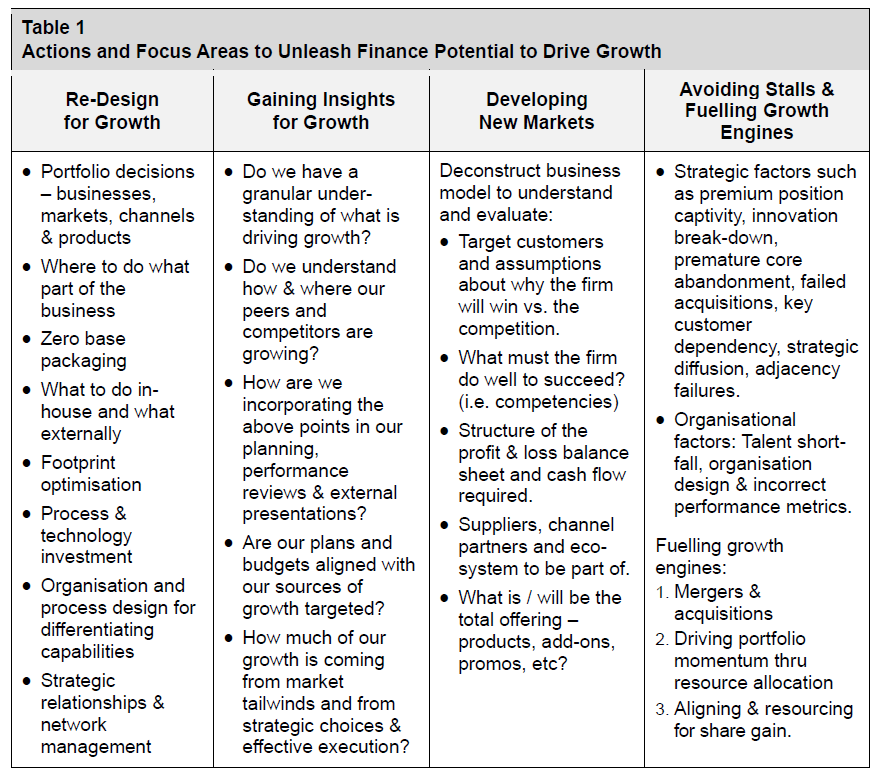
Table 1 presents a summary of finance actions for each of these four areas.
Conclusion
Profitable growth is still the key to success. There is no escaping the fact that growth is a critical driver of performance and the primary dimension to measure the impact of finance on the business. No business has saved its way to success. Objective evaluation requires leaders, together with finance, to deconstruct the business to understand and evaluate, target customers, and question assumptions about why the firm will win today and into the future, versus current and emerging competition. There must be alignment around what the firm must do well to succeed. A vision statement needs to be extended to include what a successful business P&L, balance sheet and cash flow statement will look like in the future. Finance should be allocated based on the growth stage along with the challenges and choices the organisation needs to address to achieve their vision.
Delivering value-add strategic financial insights that facilitate growth renewal through new opportunity development and revenue portfolio revitalisation should be a key finance focus. The transition of finance to a strategic growth enabler requires moving from historian to futurist, with prediction and prescriptive recommendations to help leaders navigate uncertainty. Business partnerships help to develop scenarios and simulate the impact of strategic investments. It is important to optimise capital allocation and cash flow. Also, the right insights have to reach the right decision makers in a timely manner to reduce missed opportunities. Managing data is a strategic asset to help identify quick win opportunities and funding to build momentum.
Resource allocations need to strike the right balance of improving performance of the core, creating new growth platforms and investing in strategic options with the potential to be future growth drivers (McGrath & MacMillan 2009). While compliance, control and risk management are important. There is a hidden cost of being a compliance first culture where too many ‘No’s’ inhibit growth and encourage a culture of risk avoidance, versus an approach that thinks about ‘How we can’.
Bibliography
Arnold, G, (2005) The Handbook of Corporate Finance, Prentice Hall, Financial Times, Great Britain.
Bos, P, (2024) How Finance can Empower your Business to Achieve its Growth Ambitions. https://www.ey.com/en_sg/insights/private-business/how-finance-can-empower-your-business-to-achieve-its-growth-ambitions.
Couto, V, Plansky, J, & Caglar, D, (2017) Fit for Growth. A Guide to Strategic Cost Cutting, Restructuring and Renewal, Wiley, USA.
Forbes Expert Panel (2025) 19 Common Challenges Businesses Face when Trying to Scale Operations. www.forbes.com/councils/forbesbusinesscouncil/2025/05/02/19-common-challenges-businesses-face-when-trying-to-scale-operations/.
Green, J, Henneman, K, & Antov, D, (2018), Optimising Growth. Predictive and Profitable Strategies to Understand Demand and Outsmart Your Competitors, Wiley, USA.
McGrath, R, & MacMillan, IC, (2009) Discovery Driven Growth. A Breakthrough Process to Reduce Risk and Seize Opportunities, Harvard Business Press.
Moore, GA, (2015) Zone to Win. Organising to Compete in an Age of Disruption, Diversion Books, New York.
Olson, MS, & Van Bever, D, (2008) Stall Points. Most Companies Stop Growing – Yours Doesn’t Have to. Yale University Press, USA.
Viguerie,P, Smit, S, & Baghai, M, (2007) The Granularity of Growth. Making Choices that Drive Enduring Company Performance. Marshall Cavendish Limited, UK.
Wunker, S, (2011) Capturing New Markets. How Smart Companies Create Opportunities Others Don’t. McGrawHill, USA.
Zook, C, & Allen, J, (2016) The Founders Mentality, How to Overcome the Predictable Crises of Growth, Harvard Business Review Press, USA.